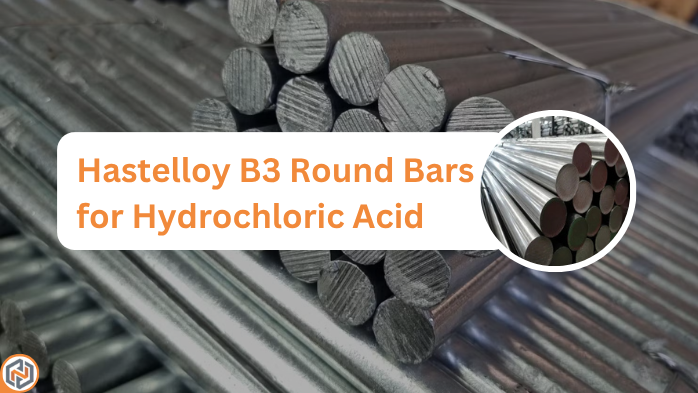
Hydrochloric acid destroys most engineering metals within months of exposure. Hastelloy B3 Round Bar solves that problem through a nickel-molybdenum composition built for reducing acid environments. Standard stainless grades pit and crack under concentrated HCl at elevated temperature. This blog explains why processors choose Hastelloy B3 round bars for hydrochloric acid service, and what to verify before specifying this alloy.
Why Does Hydrochloric Acid Require Specialized Alloy Materials?
Hydrochloric acid attacks metal through a reducing mechanism, stripping the protective oxide layers that chromium-based alloys depend on. Chromium oxide films that shield 316 or 317 stainless steel in oxidizing acids break down almost immediately in HCl. Pitting and crevice corrosion follow within weeks at concentrations above 10%. Nickel-molybdenum alloys resist this breakdown because their protection comes from molybdenum content rather than a surface film.
Why Hastelloy B3 Round Bars Perform Better in Hydrochloric Acid
Exceptional Resistance to Hydrochloric Acid
The 28-30% molybdenum content in Hastelloy B3 Round Bar neutralizes hydrochloric acid across all concentrations, including boiling conditions up to 30% HCl, keeping corrosion rates below 0.5 mm per year.
Improved Thermal Stability
Hastelloy B3 is resistant to 220°C in acid service. The carbon content is limited to 0.01%, thus preventing carbide precipitation during welding and avoiding the degradation associated with older nickel alloys.
Better Resistance to Stress Corrosion Cracking
Chloride-rich acid cracks conventional stainless steels within months under load. In pressurized reactors, the nickel-molybdenum matrix of Hastelloy B3 withstands cracking by chloride and ensures the reliability of shafts and fasteners under continuous exposure.
Excellent Fabrication and Weldability
Silicon capped at 0.10% and minimal carbon let Hastelloy B3 accept welding without post-weld heat treatment, giving fabricators the flexibility to machine complex geometries without cracking risk.
Long Service Life in Chemical Processing Equipment
Plants replace stainless components in HCl service every 2-3 years. Hastelloy B3 equipment routinely runs 15-20 years before replacement, cutting shutdown frequency across reactors, piping, and heat exchanger systems.
Typical Industrial Applications
Chemical processing plants use Hastelloy Alloy B3 Bars for acid production reactors, transfer piping, and agitator shafts. This resistance is applied in heat exchangers that deal with hydrochloric acid. Manufacturers of pharmaceuticals opt for it for the synthesis of chlorinated compounds.
Material Selection for Critical Acid Service
Certified mill test reports confirm chemical composition and mechanical properties before installation. Uncertified material introduces batch variation, but traceability documentation protects against counterfeiting of alloy substitution.
Factors to Consider Before Choosing Hastelloy B3 Round Bars
- Acid concentration: HCl above 20% at elevated temperature demands thicker wall sections or higher-grade verification before fabrication.
- Operating temperature: Sustained service above 200°C narrows corrosion resistance margins, requiring closer monitoring and periodic wall thickness checks.
- Fabrication requirements: Welded assemblies need certified procedures matching the alloy’s low-carbon chemistry to avoid intergranular corrosion at seams.
- Pressure conditions: High-pressure reactors and piping need thicker round bar stock, verified against code calculations for the application.
- Material certifications: Working with a certified Hastelloy B3 round bar supplier ensures mill test reports and chemical analysis accompany every batch.
Common Mistakes to Avoid When Selecting Materials for Acid Service
Procurement teams buy materials based purely on unit price, ignoring the cost of frequent replacement and downtime. Failure occurs prematurely when actual acid concentration is not as assumed in the design but specified without regard to actual acid concentration. In batch processes the operating temperature is often neglected as the peak temperature is higher than the steady state average. Certification verification skipped lets substandard alloy on site, creating liability on failure. The most costly mistake is to assume all nickel alloys behave equally in HCl. Hastelloy C276 resists oxidizing acids well but underperforms Hastelloy B3 in reducing acid conditions.
Why the Right Material Choice Matters
Material failure in hydrochloric acid service rarely stays contained to one component. A broken shaft or corroded pipe can cause entire process lines to shut down, leading to downtime and a safety review. Hastelloy B3 Round Bar eliminates this risk with its resistance to corrosion in reducing acid environments. The source is just as important as the alloy specification. Hastelloy B3 round bars are fully traceable and certified, and are available from Niko Steel & Engineering LLP for chemical processing applications where acid-handling equipment cannot tolerate any uncertainty of material.