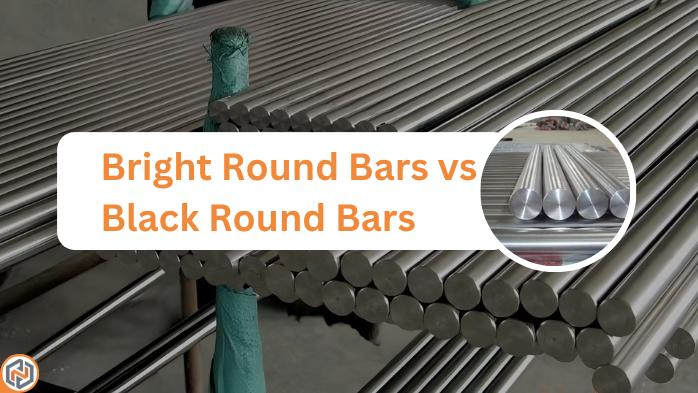
Bright bars and black bars start as the same round bar stock, yet a few processing steps separate them. Producers pull, peel, or grind hot-rolled bar to create bright bar, while black bar ships straight from the rolling mill with no further shaping. Fabricators choose between the two based on machining needs, project budget, and surface visibility. This blog compares bright bars and black bars across manufacturing, finish, tolerances, mechanical behavior, machining ease, cost, and industrial use, so buyers can match the right bar to the right job.
How Bright Bars and Black Bars Are Manufactured
Mills roll steel billets into round bar at temperatures above 1000°C, then let the bars air cool on the mill floor. That hot rolled bar becomes black bar the moment it leaves production, with no additional shaping applied. Bright bar starts from the same hot rolled stock but goes through cold drawing, peeling, turning, or centerless grinding at room temperature. Cold drawing pulls the bar through a die smaller than its original diameter, compressing the grain structure and tightening the outer surface. Black bar keeps the visible scale, minor surface scratches, and diameter swings of a few millimeters that come with hot rolling. The extra processing on bright bar adds cost and time but delivers a bar ready for precision work straight off the rack.
Bright Bars vs Black Bars: Key Differences
Surface Finish
Bright bar leaves the mill with a smooth, reflective surface, free of mill scale, due to cold drawing or grinding. Black bar retains a rough, dark oxide layer straight from hot rolling. That difference shows up immediately in appearance and touch. Machinists favor bright bar for exposed parts since it needs little additional finishing, while black bar gets machined down first for visible components.
Dimensional Accuracy and Tolerances
Cold drawing and grinding hold bright bar to tolerances as tight as ±0.05 mm on smaller diameters, compared to black bar’s rolling mill tolerance of ±1 to ±3 mm depending on size. That precision matters when a part must fit a bearing, bushing, or mating component without secondary turning. Black bar suits structural framing or general fabrication, where a few millimeters of variation never affects performance.
Mechanical Properties
Cold working during bright bar production raises yield strength and surface hardness, though it can reduce ductility slightly. Black bar keeps the as-rolled grain structure, giving it more uniform ductility but lower surface hardness. Alloy steel round bars processed as bright bar show 10 to 15 percent higher yield strength than the same grade in black bar form.
Machining and Fabrication
Bright bar cuts cleaner and faster on a lathe since no scale dulls tooling or throws off measurements. Black bar is the material of choice for welders fabricating structural work where the surface is ready for weld beads without further preparation. Bright bar is best for components that are machined to final dimension with minimal stock removal.
Cost and Material Availability
Black bar costs less to produce since it skips cold finishing operations, while bright bar carries a higher cost tied to its extra processing steps. Both remain available across common alloy steel round bar grades and sizes, though bright bar options run more limited in larger diameters. Project budgets and finish requirements decide which one gets specified.
Common Industrial Applications
Black bar shows up in structural fabrication, construction framing, and general engineering work where strength matters more than surface finish. Bright bar fits precision components such as automotive shafts, hydraulic fittings, bushings, and machined parts used across oil and gas and power generation equipment. Petrochemical and pulp and paper plants use both forms, choosing black bar for support structures and bright bar for parts requiring tight fits and smooth mating surfaces.
Comparison Table
Bright bar and black bar differ across six practical factors that shape material selection for any fabrication project. The table below lines up manufacturing process, surface finish, dimensional tolerance, machinability, cost, and typical applications for a quick, side-by-side comparison.
| Factor | Bright Bar | Black Bar |
| Manufacturing Process | Cold drawn, peeled, or ground after hot rolling | Hot rolled, no secondary finishing |
| Surface Finish | Smooth, reflective, scale-free | Rough, dark mill-scale surface |
| Dimensional Accuracy | Tight tolerance, down to ±0.05 mm | Wider tolerance, ±1 to ±3 mm |
| Machinability | Minimal prep, faster cutting | Requires scale removal before machining |
| Cost | Higher due to extra processing steps | Lower, fewer production steps |
| Typical Applications | Automotive shafts, bushings, hydraulic fittings | Structural framing, construction, general fabrication |
Which One Should You Choose?
Choosing between bright bar and black bar starts with the machining requirement. A part needing a fine finish or a tight fit calls for bright bar, while structural or welded assemblies rarely need anything beyond black bar. Dimensional tolerance is next. Bushings, shafts and hydraulic components need the consistency of bright bar, but framing can handle the wider swing of black bar. Cost vs. performance also plays a role. The extra processing of the bright bar adds cost that only pays off when precision matters. Alloy steel round bars are available in either form and a grade and finish matching the end application prevents costly rework later.
Making the Right Choice for Your Application
Bright bars and black bars start as the same hot-rolled stock, but cold finishing distinguishes them in terms of surface quality, tolerance and machining behavior. Bright bar provides a smooth, close-tolerance bar for precision components. Black bar reduces costs for structural and general fabrication work. The right choice depends on how much tolerance is needed, how much machining the part can take and where it will end up in service. You can source both grades from a trusted alloy steel round bar supplier like Niko Steel & Engineering LLP for consistent chemistry, verified mill certificates and stock availability in the sizes needed for civil engineering, automotive and oil and gas projects.