Introduction
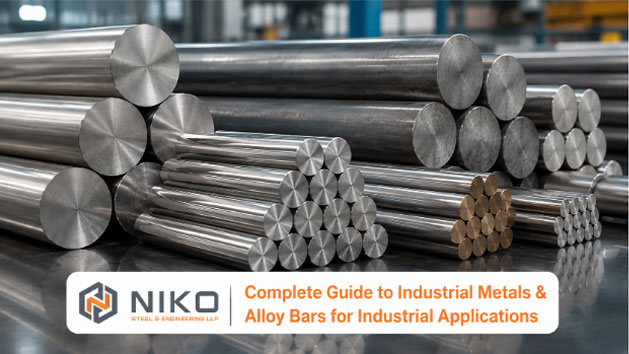
Industrial metals and alloy bars serve as the structural backbone of modern engineering, underpinning critical fabricated components from high-torque pump shafts to heavy-duty fasteners. Because material selection directly dictates equipment service life, choosing an incorrect grade can cause severe corrosion or thermal fatigue, destroying parts within months. Engineers utilise four main types of bars to solve the problems of industry. These include stainless steel bars for corrosion resistance, duplex and super duplex bars for marine environments, nickel alloy bars for harsh chemical and thermal conditions, and titanium bars for unsurpassed strength-to-weight ratios. The optimal bar profile is a function of the operating conditions: mechanical loads, pressure ratings, temperature and chemical exposures.
What Are Industrial Metals and Alloy Bars?
Industrial metal bars are solid stock used as raw input for machining, forging, and fabrication. Alloy bars add elements to a base metal to boost strength or corrosion resistance. Standard stock ships in fixed lengths and set sizes, with custom dimensions available.
Types of Industrial Bar Products
Round bars suit shafts. Hex bars suit fasteners and tooling. Square bars work in structural framing, flat bars serve brackets, and forged or bright bars add tighter tolerances with a refined finish.
Stainless Steel Bars for Industrial Applications
Bars of stainless steel are an alloy of iron and chromium, usually with nickel and molybdenum, that does not rust in a wide range of temperatures.
Key Characteristics of Stainless Steel Bars
Self-healing chromium oxide layer providing corrosion resistance. Mechanical strength can withstand structural loads. Machinability is uniform throughout conventional grades.
Common Grades of Stainless Steel Bars
SS 304 covers general-purpose work. SS 316 and 316L add molybdenum for chloride exposure. SS 321 and 347 resist sensitisation during welding, and precipitation-hardened grades add strength for aerospace work.
Industrial Applications of Stainless Steel Bars
Chemical plants use these bars for shafts and fasteners. Food and pharma facilities need them for hygiene compliance. Oil and gas uses them in valve stems and fittings.
Duplex & Super Duplex Bars for High-Performance Applications
Duplex stainless steel blends austenitic and ferritic microstructures roughly equally. Super duplex grades raise chromium, molybdenum, and nitrogen further.
Key Properties of Duplex & Super Duplex Bars
Tensile strength runs nearly double standard austenitic stainless steel. Chloride stress corrosion resistance holds up in seawater, and pitting resistance stays high in stagnant zones.
Common Grades of Duplex & Super Duplex Bars
Duplex 2205 covers most offshore and chemical duty. Super Duplex 2507 handles more severe chloride and pressure conditions.
Industrial Applications of Duplex & Super Duplex Bars
Offshore systems use duplex bars in saltwater-exposed components. Desalination plants need them where brine accelerates pitting. Chemical facilities specify duplex for mixed-acid duty.
Nickel Alloy Bars for Extreme Service Conditions
Nickel alloy bars handle conditions beyond stainless steel’s limits, particularly extreme heat and aggressive acids.
Key Properties of Nickel Alloy Bars
Corrosion resistance spans acids, alkalis, and chlorides. High-temperature stability holds properties beyond 800°C in several grades.
Common Nickel Alloy Grades
Inconel bars dominate high-temperature service. Monel bars resist seawater well, Hastelloy handles mixed acids, and Nickel 200/201 suits high-purity caustic service.
Industrial Applications of Nickel Alloy Bars
Petrochemical plants use nickel alloy bars in acid-exposed reactors. Power plants specify them for turbine parts. Aerospace relies on them for engine components.
Titanium Bars for Lightweight and Corrosion-Resistant Applications
Titanium bars pair a strength-to-weight ratio beating most steels with corrosion resistance rivalling nickel alloys, at roughly 40 percent lower density than stainless steel.
Key Characteristics of Titanium Bars
Lighter parts through strength/weight ratio. Stable oxide layer resists chlorides Biocompatibility for medical implants
Common Grades of Titanium Bar
Grade 2 is Commercially Pure. Ti-6Al-4V is the Grade 5 alloy with better strength and Grade 7 has palladium to reduce acid conditions.
Industrial Applications of Titanium Bars
Aerospace uses titanium to save weight. Salt water resistance for marine equipment. Its biocompatibility makes it useful for medical purposes.
Comparing Stainless Steel, Duplex, Nickel Alloy, and Titanium Bars
Strength and Mechanical Performance
Duplex and super duplex bars usually have the highest yield strength followed closely by nickel alloys at high temperature.
Corrosion Resistance Capabilities
Nickel alloys and titanium cover the widest spectrum of hostile substances. Duplex is best against chloride stress cracking.
High Temperature Performance
Nickel alloys maintain integrity at the highest temperatures. Duplex looses strength at about 300°C.
Weight and Fabrication Considerations
The most obvious weight advantage is titanium but it requires specialised welding equipment.
Cost and Life Cycle Value
Stainless steels are the least expensive initially, nickel alloys and titanium reduce frequency of replacement under severe service.
Factors to Consider When Selecting Alloy Bars for Industrial Applications
A grade application is matched to the complete operating environment, not a single variable.
Corrosion Exposure
Pinpoint exact environmental factors like saline exposure, aggressive chemical concentrations, pH levels, and relative humidity. Choosing improper alloys risks premature pitting, stress corrosion cracking, or uniform surface degradation during active service.
Temperature Requirements
Need to assess the baseline operating temperatures and transient thermal spikes. Temperature extremes can substantially affect the yield strength, creep strain may occur, or material embrittlement can result, hence precise thermal characterisation is very important for continuous structural integrity.
Mechanical Load & Pressure
The estimated operational stresses, dynamic fatigue and shock loads against the yield and ultimate tensile strength of the alloy are calculated. By keeping the proper safety margins, you can avoid permanent distortion of parts or sudden mechanical failure under stress.
Fabrication and Machining Needs
How will the material behave with planned manufacturing procedures such custom machining, welding, bending or heat treating? A grade chosen for maximum workability will reduce tool wear, shorten production cycles and minimise cost.
Industry Standards and Specifications
Make sure the metal you choose conforms to the appropriate norms and standards, whether it’s ASTM, ASME or DIN. Formal certification ensures material traceability, consistent quality control and legal compliance prior to final procurement.
Industries That Depend on Industrial Metals and Alloy Bars
Oil & Gas Industry
In the oil and gas industry, bars for downhole tools and pipes must withstand pressure and sour gas at the same time.
Chemical and Petrochemical Industries
Bars must stand up to acids and heat: crucial for reactors and transfer lines.
Sector Marine & Offshore
Structural elements must tolerate frequent exposure to salt water.
Power Generation Sector
They need alloys for turbine shafts in the power generating business that will hold their strength for a long length of time at high temperatures.
Engineering & Aerospace Industry
Titanium and high strength nickel alloys are used for weight sensitive components.
Construction & Heavy Manufacturing
For structural framing, stainless steel and alloy steel bars are used due of their endurance.
Benefits of Using High-Performance Alloy Bars in Industrial Applications
Choosing the right alloy bar contributes to equipment reliability and also increases the service life. Downtime is minimised when components resist the specific wear mechanism to which they are exposed, whether it is pitting, fatigue or thermal creep. Safety is improved, cost efficiency is increased and performance is enhanced in demanding processes.
Conclusion
The ideal industrial metal or alloy bar is chosen by matching the material qualities to the application, not only the price. Stainless steel bars, duplex and super duplex bars, nickel alloy bars and titanium bars all offer different benefits from general corrosion resistance to severe temperature stability to marine-grade durability. Since 1981, Niko Steel & Engineering LLP has stored and supplied this complete range of bar grades, matching material to the work for fabricators and engineers.