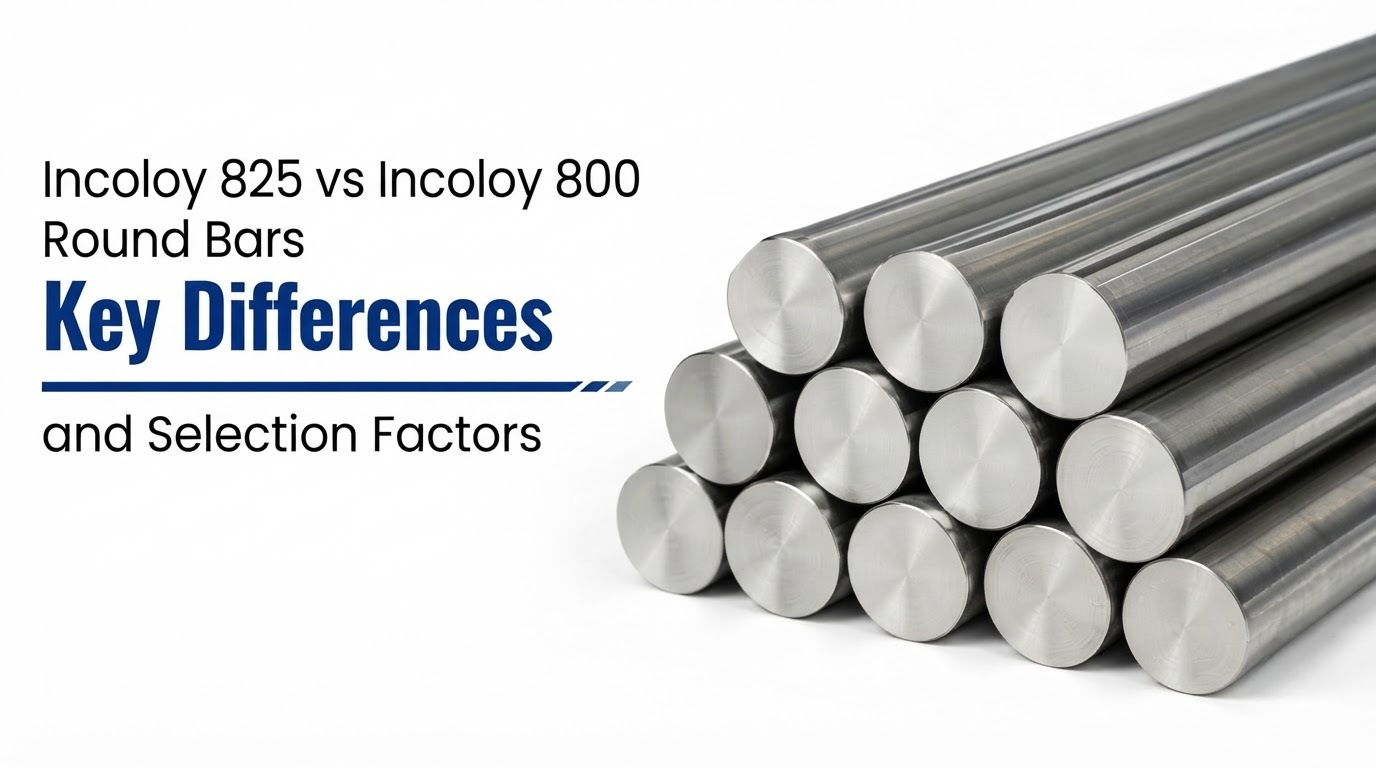
Incoloy 825 and Incoloy 800 both belong to the nickel-iron-chromium alloy family, and that shared lineage leads some buyers to consider them interchangeable. Both alloys are used in severe industrial service, but their corrosion resistance and service environments differ in ways that affect actual performance. For applications requiring Incoloy 825 round bars, understanding these differences helps ensure the alloy is selected according to the specific operating conditions.
What Is Incoloy 825?
Incoloy 825, registered as UNS N08825, is a nickel-iron-chromium alloy strengthened with molybdenum, copper and titanium. These additions give the material broad resistance to reducing and oxidising substances alike. The alloy resists pitting, crevice attack and chloride stress corrosion cracking in environments such as sulphuric acid, phosphoric acid and seawater. Chemical processing plants, pollution control systems and marine equipment rely on this resistance. Engineers specify this grade when the process stream contains a mix of acids rather than one predictable corrosive agent.
What Is Incoloy 800?
Incoloy 800, registered as UNS N08800, also starts from a nickel-iron-chromium base. The grade resists oxidation and carburisation at sustained high temperatures, with continuous service ratings up to around 1100°C in oxidising atmospheres. Furnace components, heat treatment fixtures, radiant tubes and heat exchangers use Incoloy 800 round bars because the material holds mechanical strength and dimensional stability under thermal cycling.
Incoloy 825 vs Incoloy 800: Key Differences
The choice between these two alloys depends on which property carries more weight in a given process: corrosion resistance or elevated-temperature performance. Neither grade dominates the other. Selection depends on the operating environment, not a fixed hierarchy between the two materials. The table below summarizes where each alloy holds an advantage.
| Property | Incoloy 825 | Incoloy 800 |
| Primary strength | Corrosion resistance | High-temperature performance |
| Corrosion resistance | Excellent across a broad range of corrosive media | Good, but more application-dependent |
| High-temperature service | Suitable for elevated-temperature service, but not primarily a high-temperature alloy | Strong choice for high-temperature applications |
| Chemical processing suitability | Strong | More limited depending on environment |
| Material selection priority | Corrosive and chemically aggressive environments | Heat, oxidation and carburization resistance |
| Typical selection basis | Corrosion control | Temperature exposure |
No single line in this table declares one alloy superior to the other. A component exposed to sulfuric acid at moderate temperature calls for Incoloy 825. A furnace fixture cycling through 900°C repeatedly calls for Incoloy 800. The operating conditions determine which column applies, not a general reputation for either grade.
Incoloy 825 vs Incoloy 800: Which Should You Choose?
Select Incoloy 825 when the process involves aqueous corrosion, mixed acid exposure or chloride-rich media such as seawater. This grade earns its place in flue gas desulfurization systems, acid production equipment and offshore components precisely because chemical attack, not heat, is the dominant threat.
Choose Incoloy 800 when the component sits inside a furnace, heat treatment line or high-temperature process where oxidation and carburization drive material failure. Operating temperature is the first question to answer, followed by process chemistry, corrosion mechanism and mechanical load. A bar rated for 1100°C service in air behaves very differently once immersed in sulfuric acid at 60°C, and the reverse holds true as well. Match the material to the actual service environment and confirm compatibility against the applicable specification before finalizing a purchase order.
Why Source Incoloy 825 Round Bars from an Established Stockist?
Grade verification matters as much as the alloy itself. An Incoloy 825 round bars stockist with in-house testing confirms chemistry and mechanical properties before dispatch, reducing the risk of receiving mismarked or substituted material. Dimensional availability across diameters, consistent surface finish and complete material documentation, including mill test certificates, support project timelines without delay. Niko Steel & Engineering LLP maintains stock across standard sizes of Incoloy 825 round bars and supplies material backed by full documentation for chemical processing, marine and industrial applications.
Selection Summary
- Choose Incoloy 825 when corrosion resistance in demanding chemical or aqueous environments is the primary concern.
- Choose Incoloy 800 when the component will primarily face elevated temperatures, oxidation, or carburization and the application does not demand the broader corrosion resistance of 825.
- Base the final decision on service temperature, process chemistry, corrosion mechanism, mechanical requirements and the applicable material specification.