Alloy steel round bars aren’t interchangeable just because they’re all technically “alloy steel.” Selection actually comes down to alloy composition, strength, toughness, hardenability, and the specific service conditions a component will face once it’s in use. Different grades trade these properties against each other in different ways, and picking the wrong one for a demanding application, a shaft under repeated stress, a gear that needs a hard surface and a tough core, tends to surface as a failure well after the part is already in service. Understanding what separates one alloy steel round bars grade from another is really the first step in getting that selection right.
What Makes Alloy Steel Round Bars Different?
The alloying elements added to the base steel are what actually differentiate one grade from another, not just a marketing label attached to otherwise similar material. Chromium contributes to hardenability and wear resistance, letting a bar respond more predictably and consistently to heat treatment across a batch. Molybdenum improves strength and toughness, particularly at elevated temperature, while nickel adds toughness and helps the material resist impact without becoming brittle under sudden load. These elements work together rather than in isolation, and the specific combination and proportion used in a given grade determines how that bar behaves under load, under heat treatment, and over its working life in the field. Strength, toughness, hardenability, and wear resistance are the four properties that matter most when comparing grades, and no single grade maximizes all four at once, which is exactly why the grade table below shows different steels leaning into different strengths.
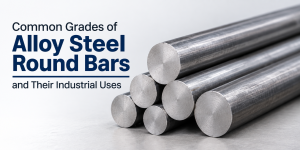
Common Grades of Alloy Steel Round Bars
| Grade | Key Characteristic | Typical Applications |
| 4140 / EN19 | Strength and hardenability | Shafts, gears, axles |
| 4340 / EN24 | High strength and toughness | Heavy-duty shafts, gears |
| 8620 | Case-hardening capability | Gears, pinions |
| 4130 | Strength with good machinability | Engineering and selected aerospace components |
4140 alloy steel round bars remain one of the most widely specified grades precisely because they balance strength and hardenability so well, making them a dependable default for shafts, gears, and axles across general engineering work where extreme conditions aren’t the deciding factor. 4340, sold in some markets as EN24, pushes further into high-strength, high-toughness territory, which is why it shows up in heavy-duty shafts and gears carrying loads that would push 4140 closer to its practical limits over time. 8620 alloy steel round bars take a different approach entirely, prioritizing case-hardening capability so the surface can be hardened while the core stays tough, which is exactly what gears and pinions need to resist wear without becoming brittle under shock loading during operation. 4130 rounds out this group with a strength and machinability combination that suits general engineering work and select aerospace components, where fabrication ease matters alongside mechanical performance, particularly on parts that need extensive machining or welding during production.
Applications of Different Grades
Matching a grade to its application works better than starting from the application and guessing at a grade, since the same industry can call for different grades depending on the specific component involved.
4140 suits shafts, axles, gears, and heavily loaded machine components where a balance of strength and hardenability handles the job without needing anything more specialized.
4340 fits highly stressed shafts, gears, and engineering components that see loads or impact conditions 4140 wouldn’t comfortably handle, where the extra toughness genuinely earns its higher cost.
8620 goes into gears, pinions, and components that specifically need a hard surface paired with a tougher core, a combination that comes from its case-hardening response rather than from bulk hardness alone.
4130 covers selected engineering and aerospace components where machinability and a solid strength profile matter together, particularly in fabricated assemblies where welding or machining happens as part of production.
This kind of grade-by-grade breakdown matters more than a broad industry list, since two components in the same industry can call for entirely different grades depending on load, wear, and heat-treatment requirements.
How to Select the Right Alloy Steel Round Bar Grade
Selection should start with the required strength and hardness the component needs to deliver in service, then move to toughness and impact loading, since a bar that’s strong but brittle fails differently than one that bends before it breaks. Wear and fatigue requirements matter next, particularly for components under repeated cyclic stress rather than a single load event, where fatigue failure can occur well below a material’s rated static strength. Hardenability determines how effectively the bar will respond to heat treatment, which ties directly into the required heat-treatment process itself and the section thickness being treated. Component size and manufacturing process affect which grades are practical to work with, since larger sections don’t always harden as consistently through their cross-section as smaller ones. Confirming the applicable material specification keeps the final selection tied to a verifiable standard rather than a general assumption about what “alloy steel” should provide. The key point worth repeating here: grade selection should be based on the component’s actual requirements, not simply the name of the application it’s going into. Two shafts can have completely different requirements depending on load, speed, and service environment, even if they’d both get called “a shaft” in casual conversation on a shop floor.
Final Considerations Before Buying
Before placing an order, confirm the exact grade and specification required, along with diameter and length matched to the component’s design. Check the supply condition, whether that’s as-rolled, normalized, or another state, and confirm the heat-treatment condition matches what the application needs. Surface finish matters for components going straight into machining, and test certificates or MTC documentation should accompany the order to verify the material actually meets its stated grade. Confirming dimensional requirements upfront, rather than assuming standard stock will fit, avoids the kind of mismatch that turns into a delay once the bar is already on the shop floor.