Round bars are essential across construction, automotive, engineering, and oil and gas industries, but their usefulness depends entirely on how well they’re made. A bar that’s out of round, inconsistently treated, or poorly finished creates problems downstream in machining and fabrication.
Modern manufacturing processes have significantly improved precision and reliability in round bar production. This blog walks through the round bar manufacturing process from raw material to finished product.
What Is a Round Bar?
Round bars represent a foundational solid cylindrical raw material for machined and fabricated components across diverse industrial sectors. Our inventory includes a wide range of diameters and materials, such as stainless, carbon, and alloy steel. These products serve as the essential starting point for shafts, fasteners, and fittings. We ensure that every bar meets the rigorous standards required for your technical applications.
Raw Materials Used in Round Bar Manufacturing
Manufacturing starts with selecting the right base material. The raw material choice determines the bar’s final properties.
- Stainless steel round bars are selected for corrosion resistance in chemical, marine, and hygienic service environments
- Carbon steel is chosen for strength and cost-effectiveness in general structural and mechanical applications
- Alloy steel round bar is specified for high-performance applications requiring hardness, heat resistance, or toughness
- Other metals, including tool steel and special alloys, depending on project requirements
Step-by-Step Round Bar Manufacturing Process
Melting and Casting
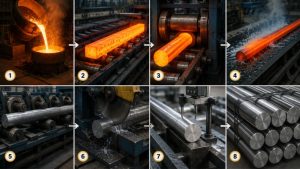
Production begins by melting raw materials in electric arc or induction furnaces. The molten metal is refined to reach the desired chemical composition and then poured into moulds to produce billets or ingots. The quality of this stage determines the consistency of the finished bar. Compositional variation here creates problems that no downstream process can fully correct.
Hot Rolling Process
Billets are reheated to working temperature and passed through a series of rolling mills. Each pass gradually reduces the cross-section and elongates the billet, forming the circular profile of the bar.
- Reduces the cross-sectional area gradually to the intended diameter.
- Improves grain structure by thermomechanical processing.
- creates the basic round bar shape that defines the product.
Cold Drawing / Finishing
Hot-rolled bars are drawn through dies at ambient temperature to improve dimensional accuracy and surface condition.
- Improves surface finish, removes mill scale, and delivers a cleaner surface for machining
- Enhances dimensional accuracy and tighter diameter tolerances than hot rolling alone
- Increases strength through cold work, improving yield strength without heat treatment
Heat Treatment
Heat treatment adjusts the mechanical properties of the bar to suit the intended application. Different cycles produce different results. Annealing, normalising, quenching, and tempering are all applied depending on grade and end-use requirement.
- Increasing the hardness quenching followed by tempering raises surface and core hardness
- Improves strength-controlled thermal cycles to optimise the balance between strength and toughness
- Enhances durability, stress relief and normalising; improves uniformity of properties through the bar cross-section
Cutting and Finishing
Finished bars are cut to length, inspected, and prepared for dispatch.
- Cutting to size: saw cutting or shearing to standard or customer-specified lengths
- Surface finishing: grinding, polishing, or peeling, depending on finish requirement
- Straightening and polishing: final straightening ensures bars meet straightness tolerances for machining
Quality Control in Round Bar Manufacturing
Quality checks run throughout the process, not just at the end. Each stage has inspection gates.
- Dimensional inspection: of diameter, roundness, and length measured against specification
- Surface quality checks: visual and instrument inspection for seams, laps, or decarburisation
- Mechanical testing, tensile, hardness, and impact tests confirm properties match the declared grade
- Compliance with standards ASTM, EN, and other applicable standards is verified before release
Modern Manufacturing Techniques
Technology has significantly improved what modern round bar production delivers compared to older methods.
- Automated rolling mills provide consistent dimensional control across high-volume production runs
- Precision machining, grinding and peeling lines hold tighter tolerances than traditional finishing
- High-tech inspection tools like lasers and sound waves locate hidden flaws while keeping the material perfectly intact.
- Improved consistency and efficiency of digital process control reduces batch-to-batch variation
Applications of Round Bars
Manufacturing quality directly affects application performance. A bar with consistent properties and accurate dimensions machines better, holds tighter tolerances, and delivers more reliable finished components.
- Construction reinforcement members and structural connection components
- Manufacturers make car parts like shafts, axles, and gears to very exact sizes
- Engineering spindles, couplings, and machine tool components requiring dimensional accuracy
- Oil and gas downhole tools and pressure-rated fittings where material integrity is critical
Advantages of Modern Round Bar Manufacturing
Modern production techniques have transformed the quality and performance of steel components. Here is how advanced manufacturing improves the advantages of round bars:
- Automated rolling and finishing ensure high precision by maintaining much tighter dimensional tolerances.
- Modern peeling and grinding lines deliver a better surface finish for immediate machining.
- Improved strength and durability are achieved through controlled heat treatments and consistent properties.
- Digital process controls guarantee consistent quality by reducing variations between different production runs.
- Fully automated lines allow for efficient production, significantly reducing handling time and throughput.
Why Choose Niko Steel & Engineering LLP for Round Bars
Niko Steel & Engineering LLP: modern round bars, full documentation, and consistent quality. We cover every grade and size. Get the reliable supply your manufacturing or engineering project needs.
- High-quality round bars meeting ASTM, EN, and relevant industry standards
- We offer many types of steel, including stainless, carbon, alloy, and tool steel in both standard and custom sizes.
- Advanced manufacturing and quality control processes back every batch
- Competitive pricing and reliable bulk supply for ongoing project requirements
- Timely delivery and consistent availability from well-maintained stock
- Experienced team supporting specification, grade selection, and procurement queries
Conclusion
Round bar quality is established during raw material selection and maintained throughout the comprehensive manufacturing process. Melting, rolling, cold drawing, heat treatment, and finishing all impact the bar’s performance during machining or fabrication. Understanding these procedures helps procurement teams ask key questions and choose vendors with quality assurance. This methodical approach guarantees that all the materials you receive satisfy the rigorous performance criteria of your industrial use.